


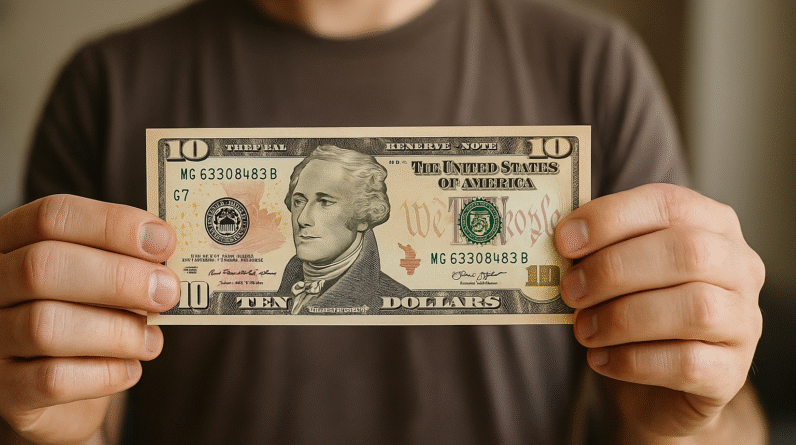
Let’s keep it simple. If you’re trying to get ahead but feel like everything costs too much or takes too long, I want to introduce you to something I call the $10 Rule.
It’s not some shiny new system or motivational buzzword. It’s just a dead-simple way of thinking that’s helped me and plenty of other Aussies chip away at extra income without needing to reinvent the wheel or wait for perfect timing.
Here’s the basic idea:
If something earns you $10 or more—and you can repeat it—it’s worth paying attention to.
Ten bucks might not sound like much. But over time, those little $10 moments can stack into something solid. Let’s break that down.
Why $10 Matters More Than You Think?
A lot of people think they need a big breakthrough to change their financial situation. They want to start a business, go viral, or land some perfect gig that pays thousands straight up. But that thinking trips folks up.
What actually gets you there is the stuff you can repeat. Mowing a lawn for $30. Flipping a chair for $40 profit. Selling a set of old rims on Marketplace. Charging $15 to run someone’s errands. These things work—and more importantly, they add up.
If you can find one hustle that reliably brings in $10 (after costs), and you do it 5 times a week, that’s $50. Over 52 weeks? $2,600.
Now stretch that out:
- Two $10 hustles a day = $20/day → $7,300/year
- Add a weekend gig at $50/day → another $5,200/year
- Just by keeping your eyes open and not dismissing the small stuff.
What Does a $10 Hustle Look Like?
Here’s a list of realistic, repeatable side gigs where $10+ is the norm. Some I’ve done myself, others I’ve seen mates have success with:
1. Facebook Marketplace Flips.
Buy undervalued stuff locally—think furniture, tools, and bikes—clean it up, and resell it for profit.
You don’t need to double your money every time. If you grab a $20 toolbox and flip it for $35, you’re ahead.
Bonus tip: Target “free” section stuff. $0 to $20 is 100% profit.
2. Lawn Mowing & Edging.
Even a basic mow can bring in $30 to $60. Just factor in fuel, wear, and your time.
Offer a loyalty discount or “neighbors’ rate” to build regulars. Do two in one street, and your time-to-money ratio improves big time.
3. Car Detailing.
Most people hate cleaning their own car properly. You don’t need a trailer setup either—just good products, elbow grease, and a bit of pride in the job.
Start with mates, build trust, and get referrals. A basic detail at $50 still gives you wiggle room for $10 to $20 profit after costs.
4. Pet Sitting or Dog Walking.
A quick 30-minute dog walk might bring in $15–$25 depending on the area.
If you walk two dogs from the same household? Double it.
You can do this before or after work—or during lunch breaks if you’re on flexible hours.
5. Collecting Scrap Metal.
Not glamorous, but I’ve made solid pocket money off old white goods, copper, brass, and car batteries.
It’s all about knowing what the yard will pay for and keeping a magnet handy. Non-magnetic = better dollars.
The Real Trick: Stack & Repeat!
Here’s where The $10 Rule becomes powerful.
Let’s say you walk a dog in the morning before work ($20), then flip a $5 item on eBay for a $15 sale in the evening. That’s $30 made without needing to change your job or invest heaps of cash.
- Now do that 3–4 days a week. It adds up faster than most savings accounts.
I used to sell old video games and parts out of my shed — just random odds and ends — and most sales were in the $10–$25 range. Was it a gold mine? Nope. But some months I cleared an extra $400 just from cleaning out junk and snapping half-decent photos.
It’s about consistency, not one-off jackpots.
Common Excuses That Kill Progress
A lot of people write off small wins because they think:
- “It’s not worth my time”
- “I’ll wait until I have more free time”
- “$10 won’t help my situation”
But let me be clear — if you’re broke or just scraping by, $10 can be the difference between fueling up or walking. Between covering an unexpected bill or borrowing again.
Start small. Then keep going.
Keeping Costs in Check
The other key to making the $10 Rule work is not blowing your profits on the way through. It’s easy to make $20 and spend $18 on fuel or impulse snacks.
So keep your costs tight:
- Batch trips (don’t drive across town for one pickup)
- Use gear you already own
- Track fuel and basic supply costs weekly
- Use free tools (Google Sheets, Canva, PayPal.Me links) instead of paid apps
This is hustle money—not investment capital. You’re not building a full company here. You’re just stacking wins.
Tools That Help (Without Spending a Cent)
Here are a few tools I use or recommend to make the small hustles easier:
- Trello or Google Keep—jot down ideas or wins so you don’t forget what worked
- Facebook Marketplace search alerts—set keywords like “free,” “tools,” “wood,” “retro.”
- Canva (free)—if you need a quick flyer or digital ad for your gig
- Snapseed or PhotoRoom (free apps)—tidy up photos for your listings
- Your phone calendar—block in hustle time so it doesn’t slip away
You don’t need fancy. You need habit.
Final Thought: Hustle Doesn’t Mean Hype.
The $10 Rule isn’t about chasing every dollar like a madman. It’s about looking at your time differently. Respecting the small wins and understanding that repeatable actions — even tiny ones — have power.
I’ve met folks who turned a few $10 flips into a small side income. I’ve also seen people scoff at that kind of thing… and stay stuck for years.
Your future doesn’t arrive in one big swing. It creeps up on you from the stuff you do regularly — the boring stuff, the small gains, the smart use of time.
So the next time you make $10 from a gig, sale, or scrap job, don’t brush it off.
Celebrate it. Then do it again.


